
Will AI make us less motivated?
On finding purpose in an era of automated hyper-productivity

Will AI make us less motivated?
It’s a question I’ve been thinking about, and maybe you have, too.
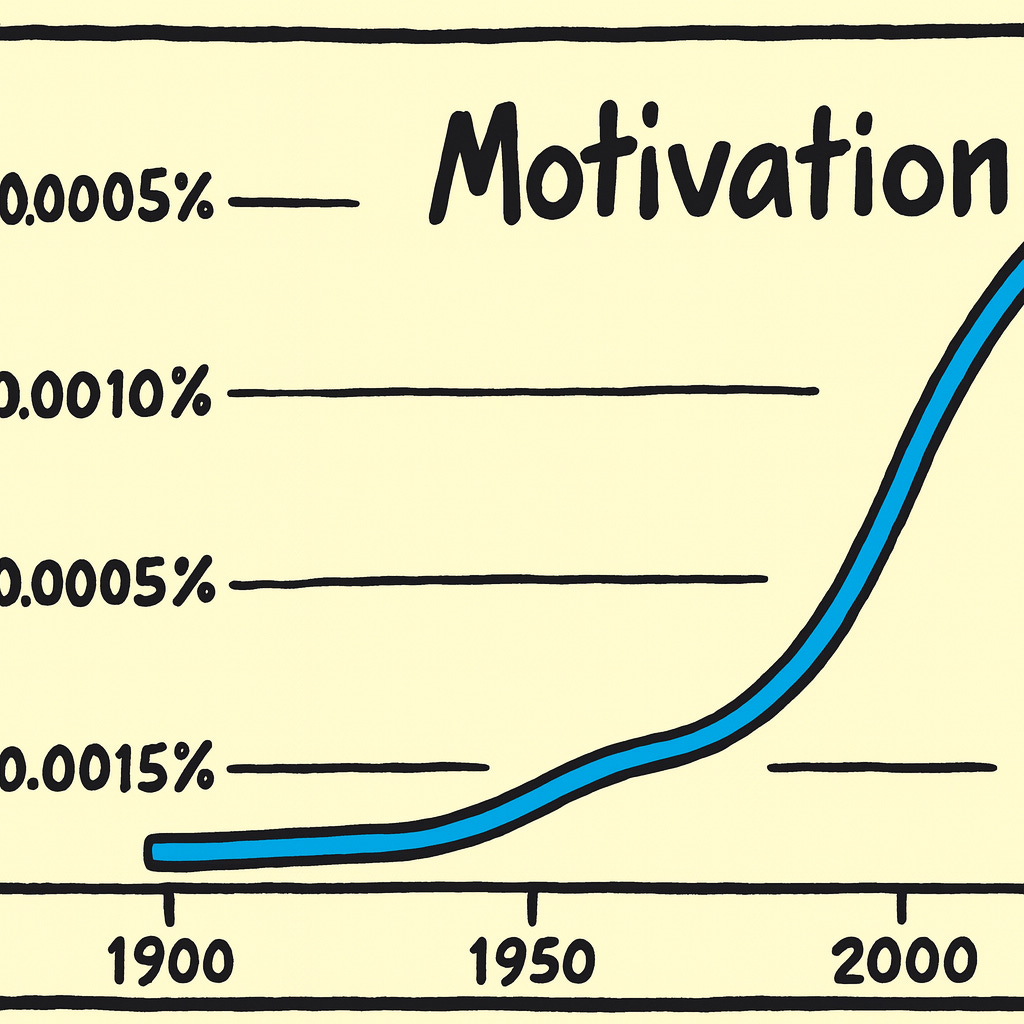
For the last 100 years, motivation has been a pillar of understanding both individual and collective human behavior, especially with respect to work. We talk about it more, write about it more, and build entire systems around it.
When I look at this chart, two moments I find myself metaphorically ‘pinning’ to the timeline.
📌 1913 — Ford invents the modern assembly line.
Work becomes optimized for efficiency, repetition, and scale. Motivation is largely external: wages, stability, output. It works, but at a cost we’re still grappling with today.
📌 2009 — Daniel Pink publishes Drive
Pink reframes motivation around autonomy, mastery, and purpose, challenging decades of carrot-and-stick thinking. It marks a cultural shift: motivation became something to design for, not demand.
Fast forward to now. Motivation is central to the narrative around engagement, but signals show a steady erosion.
📉 Culture Amp reports employee motivation has declined for consecutive years, with fewer people willing to go “above and beyond.”
📊 Gallup finds global employee engagement near historic lows.
🤖 Harvard Business Review–linked research shows that while AI boosts productivity, people often feel less motivated and more bored when they’re not using it. The findings suggest questions about the future of intrinsic motivation.
What should we make of this?
We may be compensating with language for something that’s harder to sustain in practice: meaning, agency, and energy in our work.
And now we’re entering another inflection point. AI, automation, economic pressure, and shifting values are once again redefining how and why we work.
The question I keep coming back to:
👉 Over the next 10 years, will motivation become more internal and purpose-driven? Or, increasingly outsourced to systems, incentives, and algorithms?
How do you see motivation evolving, be it personally, organizationally, and societally?