
Everything is firewood
My son's art is original. Sometimes, just before I throw it away, I wonder if it's all we have left.

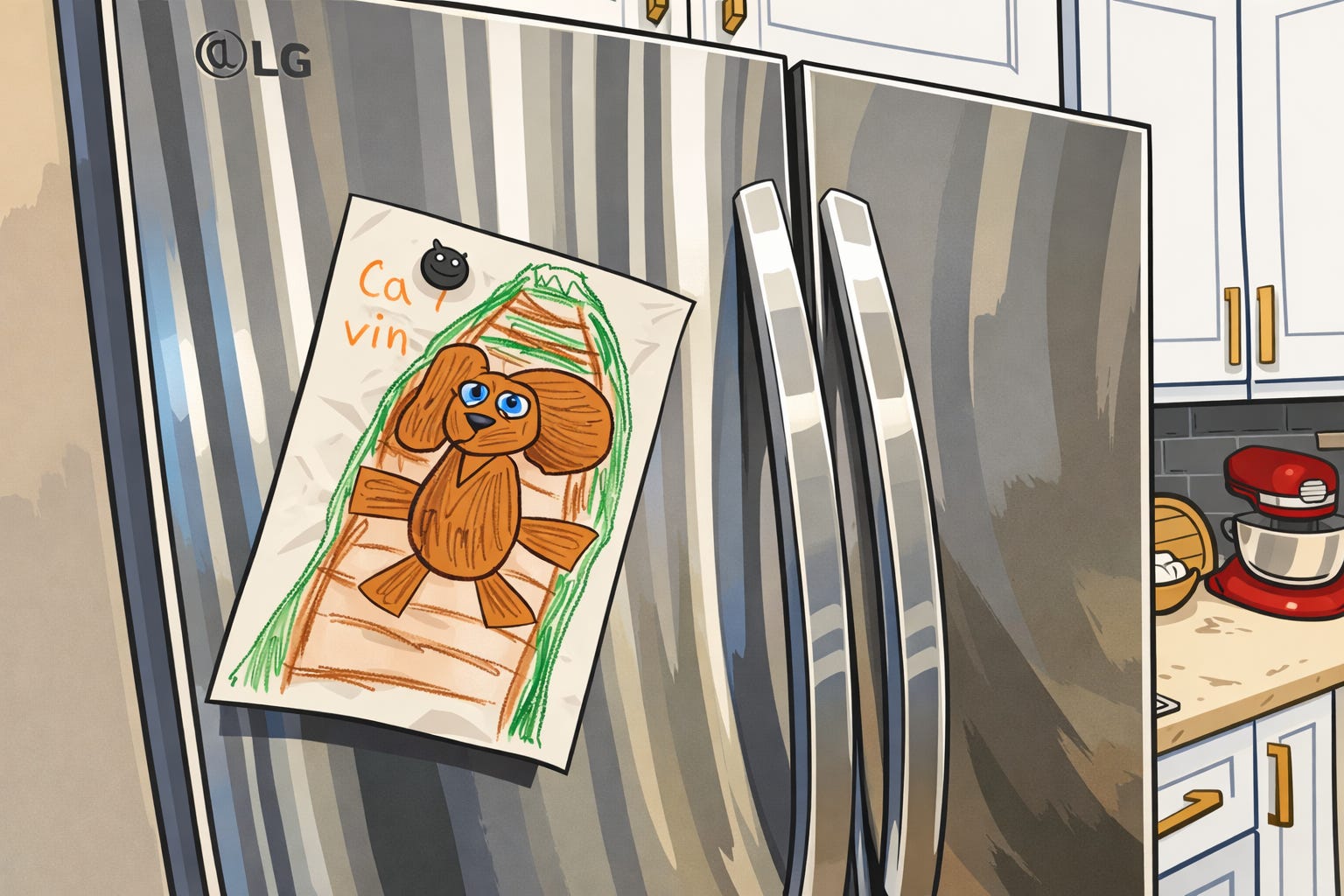
I have been a parent for nine years, which is long enough to say unequivocally: I have thrown away more of my children’s art than I care to admit, or plainly could ever remember. I do not recall the first instance, at least not specifically; only that I’m certain I was compelled to bury it under some banana peels or other basket-adjacent trash in the way a criminal would shoddily hide evidence. A frail attempt at coping with my parental guilt.
That said, I am lie-detector-he’s-telling-the-truth positive there are two questions I have never asked either of my children (my daughter now nine, my son six) about the original things they’ve made:
1. Is this real?
2. What is the point?
In case you haven’t noticed—until this week, I hadn’t—the internet is disappearing.
AI-generated content (see also: slop), bots, disinformation, ads, and censorship are killing it. Per the linked report: According to Imperva, a cybersecurity company that has been tracking this activity for more than 10 years, automated traffic on the web last year (51%) surpassed human activity, attributable mostly to the rapid adoption of large language models and AI.
This feels particularly bad to read for lots of reasons, but especially as a gateway towards an existential crises of originality. LLMs are in their infancy, but are so widely ubiquitous that people can already and easily track their behavioral patterns and trace-DNA in user-generated content across the web. One explanation (made by Marc Andreessen) is that AI (“Computers 2.0”) is inverting the adoption curve of personal computers—demonstrated today by the fact that almost everyone on earth has democratic access to the best, fastest, most sophisticated versions of these products. The same ones they’re using in venture capital board rooms in Silicon Valley.
Assuming the maturation curve and model training continue to scale at this pace, it’s only a matter of time before we reach “same question, same answer” state of affairs across Claude, Grok, OpenAI, et al.
Worst-case scenario? We’ve permanently entered the infinity loop of uninteresting replication. Welcome to the era of the World Wide Wasteland (www™).
All the qualities that once made the internet interesting and useful, and that once made the world feel large yet intimately connected, are being shrunken, broken, and buried under a deluge of such “content.”
And that’s a good word for it. We are contented by it but not informed or moved by it. It’s not news, and it’s not art. It’s not an accurate account of history, and it’s hardly a medium for conversation or good-faith debate (maybe excluding Reddit?). It’s just content—empty calories, a banal approximation of humanness that’s off by miles but measured in inches, soma pills for a brave new world. We accept it not because it’s acceptable, but because no one’s selling us anything else.
That’s not melodrama. Google, the largest search engine, doesn’t allow you to turn off its AI Overview. Under every viral post on
Now feels like a good time for a disclaimer, which is: Part of why I’m fascinated by this reality is because I notice it happening to me. With me. And if I’m not careful, for me. I started this Substack as a mechanism for authentic creative exercise and writing like, a week ago, and already I’m tempted to help me with efficiency, editing, photo illustrations—you name it.
Why?
Because AI is profoundly capable and magically immediate. And already, it is everywhere.
For goodness sake, my washing machine has an “AI Mode” setting. I have no idea how it works. Yet every single time I do the laundry, I choose it anyway.
While I’m comfortable outsourcing the tumbling of my jeans to its algorithms, I don’t believe I feel the same about my point of view.
So, I’m with you, Stanford d.school. When it comes to making things, I’m not sure I want the “easy button.”
Said differently, by the aforementioned creative sherpa, Rick Rubin:
I’m interested in the artists I’m interested in because of their point of view. I don’t believe AI has a point of view.
Thumb-stopping.
That’s the only way I can describe this LinkedIn post (via Sam Spurlin) from last week.
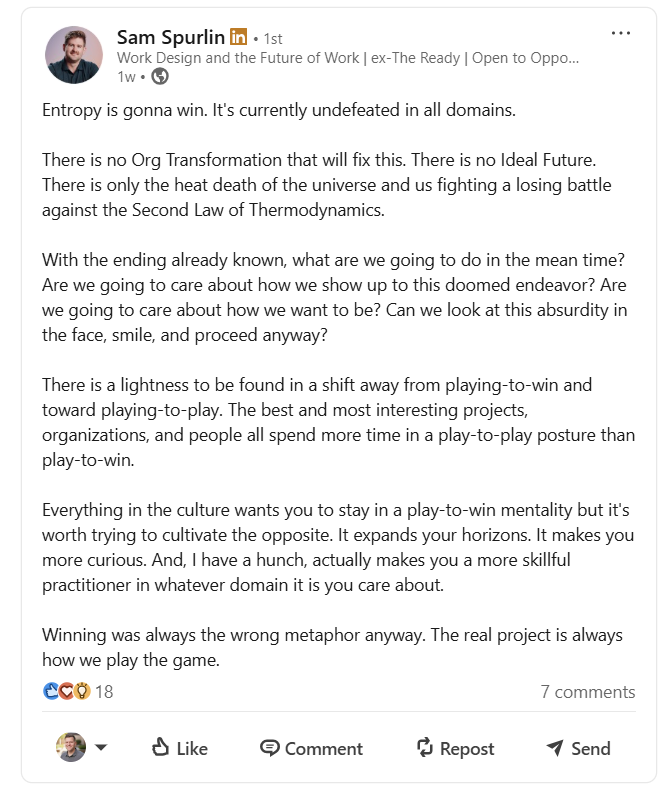
I read it once. I read it again. I read it a third time.
There is no Ideal Future. There is only the heat death of the universe and us fighting a losing battle against the Second Law of Thermodynamics.
He didn’t say it, but he said it.
Everything is firewood.
In a world where the internet becomes a global recycling factory for all of humanity’s knowledge and information, what is there to make of our original ideas?
To quote Rebecca Natale, one more time for good measure:
If artificial, low-trust content is what now populates the internet, dwarfing humans and their own contributions—which, by the way, are increasingly informed by this same content—then how is what’s left not some kind of meta wasteland where LLMs are just feasting on their own excrement? What happens when the internet eats itself?
My son’s name is Calvin. When Calvin makes a picture of our dog, Lego, he does not think about photorealism. He does not think about its merits. He does not worry whether it will end up forgotten: Be it in a folder, hung on the fridge, put in a picture frame, or (subtly hidden) in a garbage can. He just draws, because that is what he feels like doing. It is creativity in the purest form, unburdened by audience.
One of my favorite authors names is Shea. Shea, as in Shea Serrano, as in the author of five New York Times bestselling books, including Expensive Basketball, The Rap Year Book, and Basketball and Other Things. He is remarkably talented, a writer who has endeared himself to an incredibly loyal following of readers and earned widespread acclaim for his unique, memorable, individualized style on sports and culture.
If you ask me the best thing he’s made, it’s not a book. It’s not a TV show. It’s not a single tweet, or Substack, or blog. It’s his calling card for everything he makes.
This is the most important thing I’ve ever written.
He writes it all the time. He wrote it three days ago.
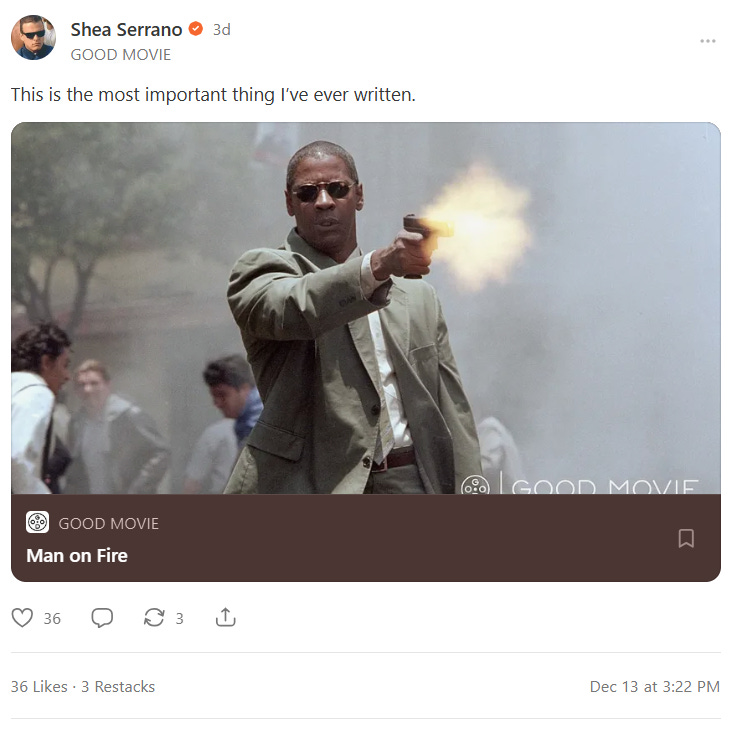
My burning question: Really? After a decade of achievement, accomplishment, validation for his work, does Serrano really believe what he makes today is more important than the things that have earned him acclaim?
What is the origin story of this phrase? Naturally, I asked ChatGPT.
There’s no specific origin story documented publicly for Serrano’s use of “this is the most important thing I’ve ever written.” It appears primarily as a promotional, hyperbolic phrase in his social/Substack posts, fitting his energetic and humorous voice. It’s less a literal claim and more a style of enthusiastic self-promotion amplified by his followers.
So maybe AI doesn’t know everything. Unsatisfied, I took a flier. I asked Serrano himself—via Substack direct message, via Good Movie.
Within minutes, he responded.
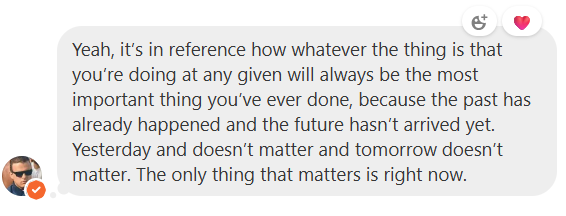
Sam said it. Shea said it. Instinctively, my son knows it.
Everything is firewood.
The only thing that matters is right now.