The most widely adopted metric system in the world today is the International System of Units, abbreviated as SI (from the French Système international d’unités). As the official system of measurement for nearly every country, it is used exclusively by roughly 95% of people on earth in science, technology, and international trade. It is built on seven fundamental physical quantities: meter, kilogram, second, ampere, kelvin, mole, and candela.
To my knowledge—not even in the United States, with our bespoke U.S. Customary System—cigarettes are not, and have never been, an official unit of measurement.
Maybe they should be.
Cigarettes are our only hope.
It’s plausible that if you have a smartphone, or children—or, like me, both—you’ve heard Australia last week became the first country to ban social media for children under 16.
Ten of the biggest platforms were ordered to block children or be fined up to $33 million under the new law beginning Wednesday, Dec. 10. The law has been criticized by major technology companies and free speech campaigners, but praised by parents and child advocates.
The ban is being closely watched by other countries considering similar age-based measures as concerns mount over the effects of social media on children’s health and safety.
“While Australia is the first to adopt such restrictions, it is unlikely to be the last,” Tama Leaver, a professor of internet studies at Curtin University, said.
Unbeknownst to me—I’ll be the first to admit my civic illiteracy as a mostly apathetic, low-information voter—there’s already energy (lots of it, turns out) on this front in the U.S.
The 25 U.S. states that have attempted to introduce some kind of legislation to this effect–you can see them in the map below, from government relations company MultiState–have approached the topic with varying levels of stringent expectation for social media companies, starting with the age of users that would be allowed to sign up for an account.
All of this [gestures at headlines, diagrams] was a passing dinner topic at a holiday party I attended last week. It was lovely, generally. Other parents were there. Other parents with young kids (younger than teenagers) were there, too, including at my table.
This came up.
“Did you guys hear they banned social media for kids in Australia?”
I had not.
Momentarily, anyway, it felt like so much of everything else I regularly attempt to avoid in the indefatigable news cycle.
Hyperbolic. Sensational. Distant. Far away. Fleeting.
“It’s a profound reform, which will continue to reverberate around the world in coming months, to assist not just this generation, but generations to come,” said Australian Prime Minister, Anthony Albanese
Really?
Just then, I did what I always do.
I looked down at my phone, and I forgot.
How did we get here?
(We’re on Step 2, by the way. Please try to keep up. Oh, and, get ready to google ‘Samizdat.’)
In the spirit of our collective attention span, I’ll give a do-you-want-extra-credit (?) abbreviated history. You can start here, stop here, get lost here, and switch your difficulty to academic mode here, here, and here.
For half a decade now, the societal traffic on this narrative highway has piled up, from op-eds, to policy commentary, to lawsuits coverage, to public-health writing. In June 2024, the second breakthrough moment came when the U.S. Surgeon General, Dr. Vivek Murthy, wrote a widely publicized op-ed in The New York Times calling for warning labels on social media platforms.
In the third paragraph? A reference to tobacco studies.
It is time to require a surgeon general’s warning label on social media platforms, stating that social media is associated with significant mental health harms for adolescents. A surgeon general’s warning label, which requires congressional action, would regularly remind parents and adolescents that social media has not been proved safe. Evidence from tobacco studies show that warning labels can increase awareness and change behavior. When asked if a warning from the surgeon general would prompt them to limit or monitor their children’s social media use, 76 percent of people in one recent survey of Latino parents said yes.
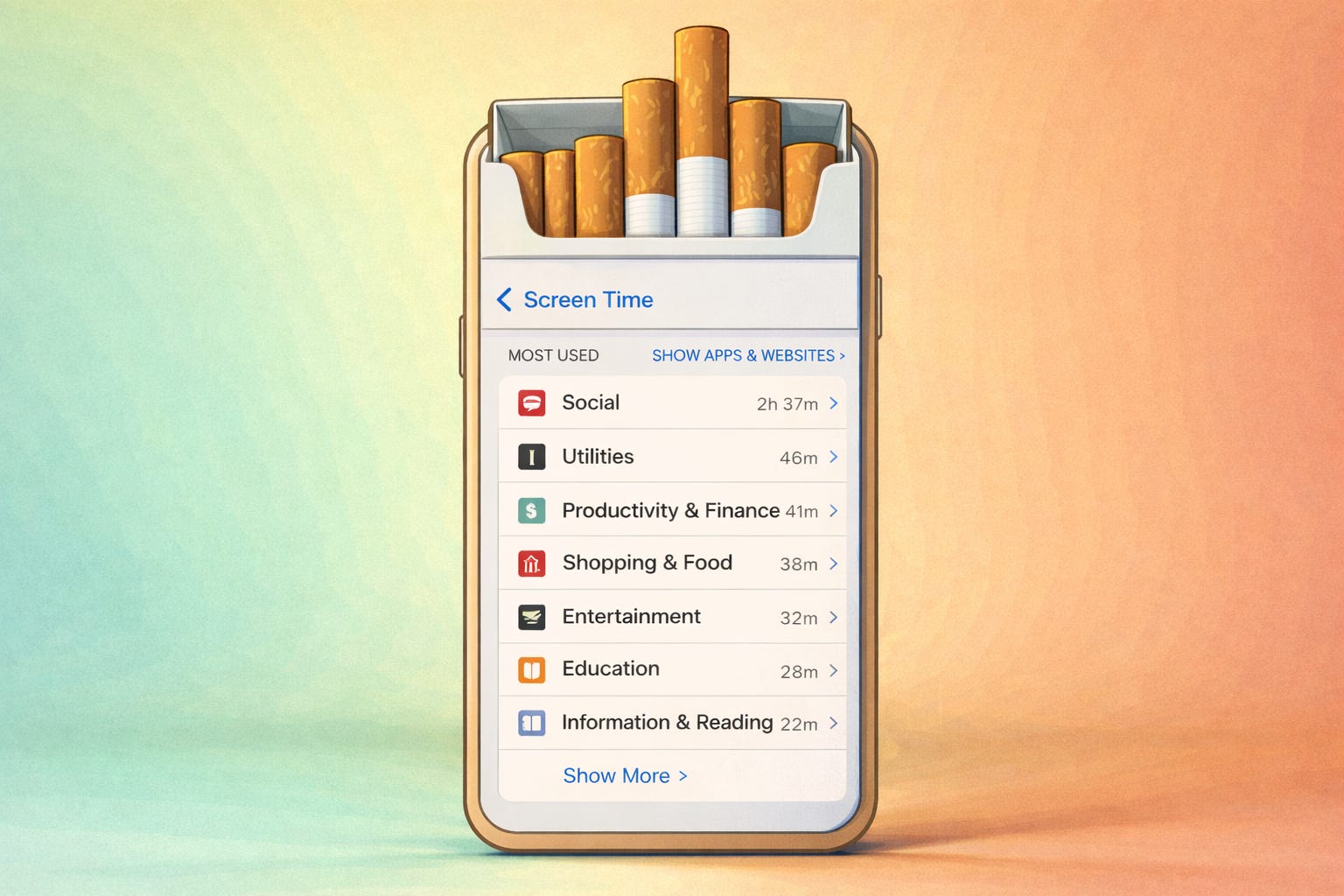
Scrolling is the new smoking.
Finally, and most timely, a TEDx talk of the same (verbatim) title, published on YouTube just a month ago, closing in on its first quarter-million views.
Says one of the men on stage:
“In the words of Neil Postman: We are amusing ourselves to death.”
Born in 1977, today he (48) is literally 10 years older than me (38) and biologically 17* years younger (18) than me.
*Editor’s note: My WHOOP age is 35 (not to brag).
Some people think he is going to die. He very much does not, and according to his latest forecasting, plans to achieve immortality by 2039. Amongst his many quirks and idiosyncrasies—for example, he’s recently been livestreaming whilst taking psychedelic mushrooms—he, too, also likes to measure things in cigarettes. If you use X, maybe he even ruined your Thanksgiving.
As you might guess, him a hundred-millionaire entrepreneur a decade my elder, we have effectively nothing in common, save only for the shared time horizon of our lifetime.
Yet if you pull that singular thread with enough tension, you do get one more thing.
The thing, actually.
You can argue there has been only one generationally profound societal reform in the last 50 years—our time(s) alive, me and Bryan—one with the gravity and the magnitude to meet belief-shattering criteria he espouses in his own point of view.
Smoking reform.
Said differently: The reclassification of smoking as an environmental hazard in shared spaces, manifested as society stopping the treatment of smoking as a private behavior and starting to treat it as a form of involuntary exposure imposed on others.
One time, at least, we identified and addressed an aspect of society that was irredeemably, evidentially, and seemingly impossibly broken, and we fixed it.
In a society (American, certainly) that has failed to successfully reform and solve virtually every other grand problem of our time—guns, education, health care, drug addiction, poverty, homelessness, climate change, income inequality, mass incarceration, food insecurity, national debt, stop me before my laptop keyboard breaks—if this is what it takes for the next reform, grab a cigarette and measure away.
Should we ban teenagers from social media? I have no idea.
With any luck, you can ask me again in 100 years. Just don’t tell Bryan Johnson.